Moving construction materials from suppliers to job sites is not always straightforward. A load of steel beams requires a different approach from a truck carrying palletized cement or bundles of timber. Cargo dimensions, weight, loading equipment, and road conditions all affect which trailer will work best.
For many construction companies and transport operators, two options are worth considering: flatbed semi trailers and side wall semi trailers.
Both are widely used for transporting building materials, but they are designed for different working conditions. A flatbed trailer offers an open platform that makes loading long and heavy materials easier. A side wall trailer provides additional side containment, which can be useful when carrying packaged goods and mixed cargo.
So, which one should you choose?
This guide looks at how each trailer performs in everyday transportation, what materials they are best suited for, and what buyers should check before placing an order.
1. What Construction Materials Can a Semi Trailer Carry?
Construction projects rely on a steady supply of materials. From steel structures to basic building supplies, these products need to be delivered safely and on schedule.
The type of trailer required depends largely on what is being transported.
Some common examples include:
- Structural steel and steel beams: Used in industrial buildings, warehouses, bridges, and commercial construction projects.
- Reinforcing steel bars (rebar): Essential for concrete foundations, columns, beams, and other reinforced structures.
- Steel pipes and sections: Commonly used in infrastructure projects, water systems, and industrial installations.
- Timber and lumber: Used for roof structures, building frames, formwork, and other construction applications.
- Plywood and building panels: Supplied to construction sites for flooring, walls, interior work, and concrete formwork.
- Precast concrete products: Including concrete slabs, pipes, blocks, and structural components.
- Packaged building materials: Such as cement bags, bricks, tiles, and other palletized supplies.
These materials are not handled in the same way. Long steel beams may need to be lifted by crane, while cement bags are usually loaded with a forklift. Some products require weather protection, while others need special supports to prevent movement during transportation.
Understanding these differences is the first step toward choosing the right semi trailer.
2. Flatbed Semi Trailer: A Practical Choice for Long and Heavy Materials
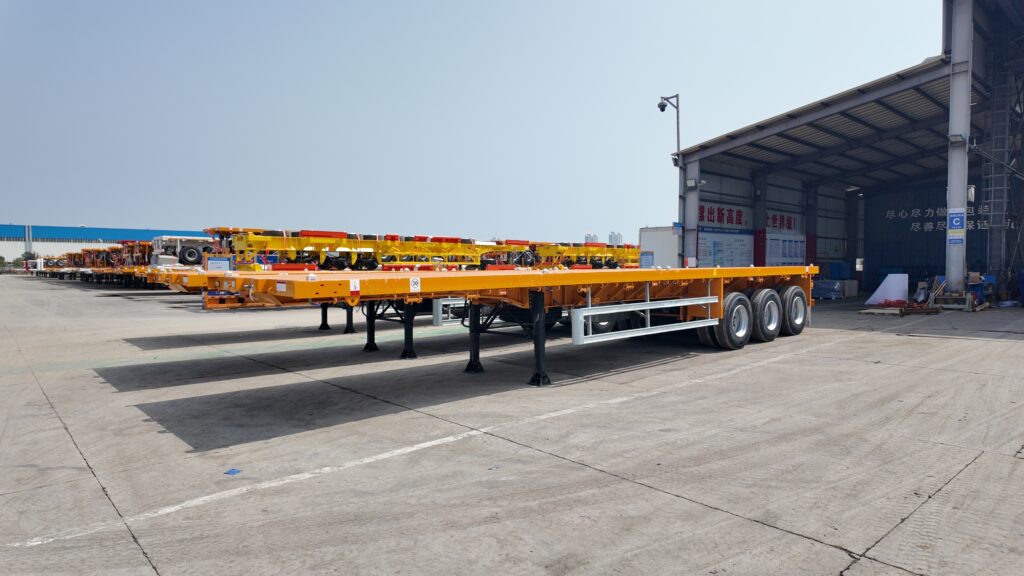
A flatbed semi trailer has an open loading platform without fixed side walls or an enclosed body. Its simple structure makes it a popular option for transporting materials that are difficult to load into conventional enclosed trailers.
Steel suppliers, construction contractors, and industrial transport companies often use flatbed trailers for this reason.
Why Do Transport Companies Choose Flatbed Trailers?
Easy access during loading
One of the biggest advantages of a flatbed trailer is the open deck.
A forklift can approach from the side, and an overhead crane can lower heavy materials directly onto the platform. There are no fixed side panels to interfere with many loading operations.
This is particularly useful when handling long steel beams, reinforcing bars, and large timber bundles.
Suitable for oversized and irregular cargo
Not all construction materials come in standard sizes.
Steel pipes, structural sections, long timber, and certain precast concrete components may require a loading arrangement that would be difficult to accommodate inside a box trailer.
A flatbed provides more freedom when positioning these materials, although the load must still comply with applicable vehicle dimension and overhang regulations.
Flexible for different transportation jobs
A flatbed trailer is not limited to one type of cargo. The same trailer may be used for steel products one day and construction equipment or timber the next, provided that its rated capacity, dimensions, and securing arrangements are suitable.
This flexibility can be valuable for transport companies serving several industries.
What Should Buyers Consider?
An open platform also means that cargo is exposed to weather and road conditions.
There are no side walls to provide additional containment, so loads must be properly blocked and secured. Loose materials, small packaged items, and moisture-sensitive products may require extra protection.
For companies transporting steel, pipes, or other heavy construction materials, the availability and rated capacity of lashing points should be checked before purchase.
Typical applications:
- Steel beams and structural steel
- Reinforcing bars
- Steel pipes and sections
- Long timber and lumber
- Selected precast concrete products
- Other heavy or oversized construction materials
3. Side Wall Semi Trailer: Better Suited to Packaged Building Supplies
A side wall semi trailer is built around a loading platform with rigid side panels. Depending on the design, the panels may be fixed, removable, or hinged.
Compared with a standard flatbed, the side walls provide an additional physical barrier around the cargo.
This design is often used by building material distributors and transport companies that handle packaged products on a regular basis.
Where Does a Side Wall Trailer Have an Advantage?
Useful for palletized materials
Cement bags, bricks, tiles, and other packaged building supplies are frequently delivered on pallets.
Side panels provide additional containment around suitable loads and can make the trailer practical for regular deliveries between warehouses, suppliers, and construction sites.
However, side panels should not be treated as a substitute for proper cargo restraints.
Convenient for mixed loads
Some building material suppliers do not transport just one product at a time.
A delivery may contain several pallets of cement, timber products, construction boards, and other packaged supplies.
A side wall trailer can accommodate a range of compatible cargo types, making it useful for businesses that handle mixed deliveries.
Flexible loading arrangements
Certain models feature removable or hinged side panels. This allows operators to open sections of the trailer when loading or unloading.
The actual level of access depends on the trailer design, so buyers should check the panel configuration before ordering.
Are There Any Disadvantages?
Side walls can make it more difficult to load unusually long or wide materials, particularly when crane access from the side is required.
They may also increase the trailer’s tare weight compared with a similar flatbed design, reducing the available payload.
Another point worth remembering is that a conventional side wall trailer is not a fully enclosed vehicle. Rain and dust can still reach the cargo unless additional covers are used.
Typical applications:
- Bagged cement
- Bricks and tiles
- Palletized construction materials
- Packaged timber
- Building panels
- Mixed building supplies
4. Flatbed vs. Side Wall Semi Trailer: Which One Should You Buy?
The two trailer types have different strengths. Rather than choosing based on appearance or purchase price alone, buyers should consider how the vehicle will be used every day.
| Item | Flatbed Semi Trailer | Side Wall Semi Trailer |
|---|---|---|
| Body structure | Open loading platform | Platform with side panels |
| Main purpose | Long and heavy cargo | Packaged and mixed cargo |
| Side loading access | Generally unrestricted | Depends on panel design |
| Crane loading | Convenient for many cargo types | Depends on panel configuration |
| Steel transportation | Particularly suitable | Suitable for selected loads |
| Palletized goods | Requires suitable restraints | Convenient for compatible loads |
| Cargo containment | Requires separate securing arrangements | Additional containment from side panels |
| Weather protection | Requires additional covering | Requires additional covering |
| Tare weight | Depends on construction | Side panels may add weight |
| Maintenance | Deck, frame, axles and restraints | Includes additional panel, hinge and locking maintenance |
A flatbed is usually the more practical option when long materials and crane loading are part of daily operations.
A side wall trailer may be a better fit for distributors handling packaged building supplies and mixed cargo.
There is no single answer for every business. The important question is whether the trailer matches the materials being transported most frequently.
5. Which Trailer Is Suitable for Different Construction Materials?
Before choosing a model, it helps to look at the actual cargo rather than simply grouping everything under construction materials.
5.1 Steel Beams and Structural Steel
Recommended trailer: Flatbed Semi Trailer
Steel beams are widely used in warehouses, bridges, factories, and large construction projects.
They are often supplied in long sections or bundles, which makes loading access an important consideration.
A flatbed trailer allows cranes to position steel directly onto the platform. It also gives operators more freedom to arrange the cargo according to its dimensions and weight distribution.
Before transportation, check the following:
- Total weight of the steel shipment
- Length and dimensions of individual beams
- Position of the cargo on the loading platform
- Suitable supports and blocking materials
- Rated lashing points and securing equipment
- Axle load and kingpin load distribution
For particularly long beams, local regulations concerning vehicle dimensions and cargo overhang must also be considered.
5.2 Reinforcing Steel Bars (Rebar)
Recommended trailer: Flatbed Semi Trailer
Rebar is commonly transported from steel mills and processing facilities to construction sites.
Because reinforcing bars are generally supplied in bundles, a flatbed trailer offers convenient access for crane loading and unloading.
The bundles need to be arranged carefully to prevent movement during transportation. Suitable blocking, chains, straps, and other rated securing equipment should be selected according to the load configuration.
For companies regularly delivering rebar to different construction projects, a flatbed trailer is often a straightforward and practical choice.
5.3 Timber and Lumber
Recommended trailer: Flatbed or Side Wall Semi Trailer
The best option depends on the length and packaging of the timber.
Long timber bundles are often easier to handle on a flatbed, especially when loading is carried out using cranes.
For shorter, packaged timber products, a side wall trailer may be more convenient. The side panels provide additional containment, while the trailer can also carry other compatible building materials.
Timber loads should be properly secured because vibration and changes in road conditions can cause bundles to shift.
For transporting loose logs, a dedicated logging trailer with suitable stakes and load restraints is generally a better option.
5.4 Cement Bags, Bricks, and Tiles
Recommended trailer: Side Wall Semi Trailer
These products are commonly delivered in pallets or other packaged units.
A side wall trailer is a practical choice for building material distributors because the panels provide additional containment around the cargo.
The load must still be secured properly. Pallets should not be allowed to slide or tip during braking and cornering.
Cement and other moisture-sensitive products also need suitable weather protection. If the transportation operation requires complete protection from rain and dust, an enclosed trailer may be worth considering.
5.5 Precast Concrete Products
Recommended trailer: Depends on the Product
Precast concrete products come in many shapes and sizes.
Concrete blocks and certain slabs can be transported on flatbed trailers, provided the deck, support points, and load distribution are suitable.
Larger wall panels and specially shaped structural components may require dedicated equipment.
For example, an A-frame trailer can be used for certain upright panel loads, while an inloader trailer may be suitable for specific precast concrete transportation operations.
The important point is to check the dimensions, weight, lifting arrangements, and support requirements before selecting the trailer.
6. Important Factors to Consider When Buying a Semi Trailer
Choosing a trailer is a long-term investment. A model that looks suitable on paper may not perform as expected if its specifications do not match the actual transportation conditions.
Here are several points worth discussing with the manufacturer.
6.1 Start with the Cargo, Not the Trailer Price
Before requesting a quotation, prepare a basic list of the materials you plan to transport.
Include their typical dimensions, average weight, maximum weight, packaging method, and loading equipment.
For example, a company mainly transporting steel beams will probably have different requirements from a distributor delivering cement and bricks.
This information helps the manufacturer recommend a more appropriate trailer configuration.
6.2 Check Payload and Weight Ratings
Payload capacity is one of the first specifications buyers usually ask about.
However, the manufacturer’s advertised payload should not automatically be treated as the legal carrying capacity on public roads.
The following factors all matter:
- Trailer gross weight rating
- Empty trailer weight
- Axle configuration and axle ratings
- Kingpin load
- Tractor specifications
- Local road and axle-load regulations
- Actual cargo weight distribution
For example, if a trailer has a gross weight rating of 34 tonnes and an empty weight of 8 tonnes, its theoretical trailer-level payload is:
34 tonnes − 8 tonnes = 26 tonnes
This calculation is only an illustration. The permitted operating payload may be lower because of axle limits, tractor ratings, load distribution, or local regulations.
Always request the actual technical specifications for the model being purchased.
6.3 Choose the Right Trailer Dimensions
The trailer should accommodate the cargo without creating unnecessary loading or transportation difficulties.
Important dimensions include:
- Overall trailer length
- Usable loading platform length
- Platform width
- Deck height
- Ground clearance
- Side wall height, where applicable
For steel and timber transportation, platform length is particularly important.
For deliveries to urban construction sites, buyers should also consider turning space, road width, and site entrance clearance.
6.4 Pay Attention to Chassis Construction
The chassis is one of the most important parts of a semi trailer.
Its design must account for the expected cargo weight, load distribution, road conditions, and stresses generated during operation.
When comparing manufacturers, ask about:
- Chassis material specifications
- Main beam design
- Crossmember arrangement
- Welding quality and inspection
- Corrosion protection
- Structural suitability for the intended application
A trailer designed for regular highway transportation may need a different configuration from one that frequently enters construction sites with uneven access roads.
6.5 Select a Suitable Axle and Suspension Configuration
Axle and suspension selection should be based on the required load, operating environment, tractor compatibility, and local regulations.
Three-axle configurations are commonly used for many heavy-duty semi trailer applications, but the correct arrangement depends on the complete vehicle combination.
Buyers should also check tire specifications, braking systems, suspension components, and the availability of replacement parts in the destination market.
6.6 Consider Cargo-Securing Equipment
A suitable load restraint system is essential for construction material transportation.
Depending on the cargo, the trailer may need:
- Rated lashing points
- Chains and tensioners
- Cargo straps
- Edge protectors
- Wheel or pipe chocks
- Timber supports
- Special cradles for selected products
Before ordering, explain the cargo types to the manufacturer and ask which securing arrangements can be supplied.
The anchorage points and trailer structure must be suitable for the loads they are expected to withstand.
7. Safe Transportation of Construction Materials
Even a well-designed trailer cannot compensate for poor loading practices.
Heavy materials can move during emergency braking, sharp turns, acceleration, and travel over uneven roads. Proper loading and securing procedures are therefore essential.
Load Distribution
Heavy cargo should be positioned to keep axle loads and kingpin loads within their permitted limits.
A shipment may be below the trailer’s total weight rating but still overload an individual axle if the cargo is incorrectly positioned.
The height and position of the center of gravity should also be considered, particularly when carrying tall or uneven loads.
Cargo Restraint
Different materials require different securing methods.
Steel beams may need chains, straps, blocking, and suitable supports. Timber bundles require appropriate restraint to prevent movement.
Palletized materials may need a combination of packaging, blocking, and straps.
Steel coils require particular care because they can roll. Depending on the coil and trailer design, a dedicated coil well, cradle, chocks, and suitable restraints may be necessary.
Side panels should not be assumed to provide sufficient protection against cargo movement during emergency braking or cornering.
Loading and Unloading
Before loading, the vehicle should be parked on a suitable surface and secured against unintended movement.
Cranes, forklifts, and lifting accessories must be appropriate for the weight and dimensions of the cargo.
Operators should also check that the loading platform and surrounding ground can safely support the equipment and load.
Regular Inspection
Transport companies should establish regular inspection procedures covering:
- Chassis and welds
- Tires and wheel assemblies
- Suspension components
- Braking systems
- Kingpin and coupling
- Cargo anchorage points
- Side panels, hinges, and locks
- Chains, straps, and other restraint equipment
Drivers should check the load before departure and recheck it during the journey in accordance with the load plan and applicable regulations.
For additional information, transport operators can consult the FMCSA Cargo Securement Rules and the UK Government’s HGV Load Securing Guidance.
These references apply to their respective jurisdictions. Buyers and operators should always follow the regulations in the country where the vehicle will be used.
8. Which Trailer Offers Better Value for Money?
The purchase price is important, but it is only one part of the overall cost of operating a semi trailer.
Fuel consumption, maintenance, loading time, spare parts, downtime, and expected service life should all be considered.
When Is a Flatbed Trailer a Better Investment?
A flatbed trailer is worth considering if most of your transportation work involves steel, pipes, timber, or other long materials.
Its open structure makes crane loading more convenient and provides flexibility when handling cargo of different dimensions.
Depending on the design, it may also have a lower tare weight than a comparable side wall trailer, leaving more capacity available for cargo.
When Is a Side Wall Trailer a Better Investment?
A side wall trailer may be more suitable for businesses delivering packaged construction supplies.
For distributors carrying cement bags, bricks, tiles, and mixed palletized products, the side panels can make everyday loading and transportation more convenient.
If the panels are removable or hinged, the trailer may also offer additional flexibility for different loading arrangements.
Look Beyond the Quoted Price
When comparing quotations from different suppliers, make sure you are comparing similar specifications.
Two trailers may have the same advertised dimensions but differ in chassis construction, tare weight, axle brand, suspension, tire specifications, braking equipment, and cargo-securing provisions.
A detailed technical comparison is much more useful than choosing the lowest quotation.
9. What Should Overseas Buyers Check Before Ordering?
For international buyers, choosing a suitable trailer involves more than confirming the model and price.
The trailer must also be compatible with local operating conditions and transportation regulations.
Before placing an order, request the following information from the manufacturer:
1. Complete technical specifications
Check the overall dimensions, usable platform dimensions, gross weight rating, tare weight, and rated loading conditions.
2. Axle and suspension details
Confirm the axle configuration, component specifications, and suitability for the destination market.
3. Chassis information
Ask about the main beam design, material specifications, structural construction, and manufacturing quality control.
4. Braking and electrical systems
Check compatibility with the tractor and the legal requirements of the destination country.
5. Cargo-securing arrangements
Confirm the number and ratings of lashing points and whether additional securing equipment can be supplied.
6. Inspection and export documents
Ask for technical drawings, inspection records, and any conformity or certification documents required for import and registration.
7. Spare parts and after-sales support
Check whether replacement parts are available and how the supplier handles technical assistance after delivery.
Buyers in Africa, the Middle East, Southeast Asia, and other export markets should pay particular attention to local vehicle dimensions, axle-load restrictions, registration requirements, and road conditions.
A trailer that works well in one country may require different specifications to operate legally and reliably in another.
A professional manufacturer should be able to discuss these requirements before production begins.
10. Common Mistakes When Buying a Construction Material Semi Trailer
Even experienced transport operators can overlook important details when comparing trailer options.
The following mistakes are worth avoiding.
Choosing Only by Purchase Price
A low quotation does not always mean a better investment.
A trailer with unsuitable specifications or components may lead to additional maintenance, unexpected downtime, and higher operating costs.
Compare the complete configuration before making a decision.
Ignoring Cargo Dimensions
Payload is important, but it is not the only specification that matters.
A trailer may have enough carrying capacity but still be unsuitable for transporting long steel beams or oversized building components.
Always confirm the actual cargo dimensions before ordering.
Overlooking Local Weight Regulations
The manufacturer’s rated capacity does not automatically represent the legal payload allowed on public roads.
Check the applicable gross combination weight, axle-load limits, and vehicle regulations in the destination market.
Treating Side Walls as a Complete Securing System
Side panels provide additional containment, but they should not be relied upon as the only means of securing heavy materials.
The complete load restraint system must be suitable for the cargo and transportation conditions.
Forgetting About Future Transportation Needs
A trailer purchased for one specific cargo type may not be suitable if the business expands into other transportation services.
Before ordering, consider the materials the company is likely to handle over the next few years.
However, versatility should never come at the expense of proper load capacity or transportation safety.
11. Frequently Asked Questions About Semi Trailers for Construction Materials
What is the best semi trailer for transporting construction materials?
The best choice depends on the type of cargo.
Flatbed semi trailers are commonly used for steel beams, reinforcing bars, pipes, timber, and other long materials.
Side wall semi trailers are often more convenient for palletized building supplies, packaged products, and suitable mixed loads.
Can a flatbed semi trailer transport steel and timber?
Yes. Flatbed trailers are widely used for both steel and timber transportation.
The cargo must be arranged correctly and secured using suitable chains, straps, blocking, and other appropriate equipment.
What is the main difference between a flatbed and a side wall trailer?
The main difference is the loading structure.
A flatbed trailer has an open platform without fixed side walls, making it convenient for long and irregular cargo.
A side wall trailer has rigid side panels that provide additional containment for suitable packaged and mixed cargo.
How much weight can a construction material semi trailer carry?
There is no universal payload figure for all construction material trailers.
The actual capacity depends on the trailer’s gross weight rating, tare weight, axle configuration, chassis design, tractor specifications, load distribution, and local road regulations.
Always request model-specific technical information from the manufacturer.
Can a side wall trailer transport steel?
Yes. A side wall trailer can transport selected steel products if the cargo dimensions, trailer capacity, loading arrangements, and securing system are suitable.
For long steel beams and cargo requiring unrestricted crane access, a flatbed trailer is often more practical.
Which trailer is better for transporting cement bags and bricks?
A side wall semi trailer is often a suitable choice for palletized cement bags, bricks, tiles, and other packaged construction materials.
The cargo still needs to be properly secured and protected against weather where necessary.
Should I choose a two-axle or three-axle semi trailer?
The right configuration depends on the cargo weight, tractor specifications, trailer design, route conditions, and local axle-load regulations.
Three-axle trailers are commonly used in heavy-duty transportation, but the number of axles alone does not determine the legal payload.
Discuss your actual transportation requirements with the manufacturer before choosing a configuration.
12. Final Thoughts: Choosing the Right Trailer for Your Business
Flatbed and side wall semi trailers both have an important place in construction material transportation.
If your business mainly handles steel beams, rebar, pipes, timber, and other long or heavy materials, a flatbed semi trailer is often the more practical option.
If you regularly deliver cement bags, bricks, tiles, and other packaged building supplies, a side wall semi trailer may be a better fit.
The decision should come down to the cargo you transport, the equipment available at loading and unloading locations, the roads you operate on, and the regulations in your market.
Before purchasing, take time to compare the trailer’s dimensions, payload ratings, chassis construction, axle configuration, and cargo-securing equipment.
Looking for a semi trailer for construction material transportation?
Whether you need a flatbed semi trailer for steel transportation or a side wall semi trailer for building material deliveries, choosing the right configuration is an important part of running an efficient transport operation.
Share your main cargo type, required loading capacity, destination country, and operating conditions with our team. We can help you evaluate suitable trailer configurations and provide a quotation based on your transportation requirements.